Cerinthe major – July 13th 2026 – Honeywort
Cerinthe major is an example of a plant we may see more often as the climate warms. This is a native plant of countries in the Mediterranean basin, with warm wet winters and hot dry summers. Our own climate is heading in that direction.
Cerinthe became popular with British gardeners quite recently, especially in the south where heatwaves are frequently in the news and average summer temperatures are several degrees higher than in Scotland. In horticulture, Cerinthe has ornamental value – it is quite unusual-looking, used by suburban gardeners to create an eye-catching display in the herbaceous border, decorating rough edges with its waxy blue-green leaves and nodding posture.

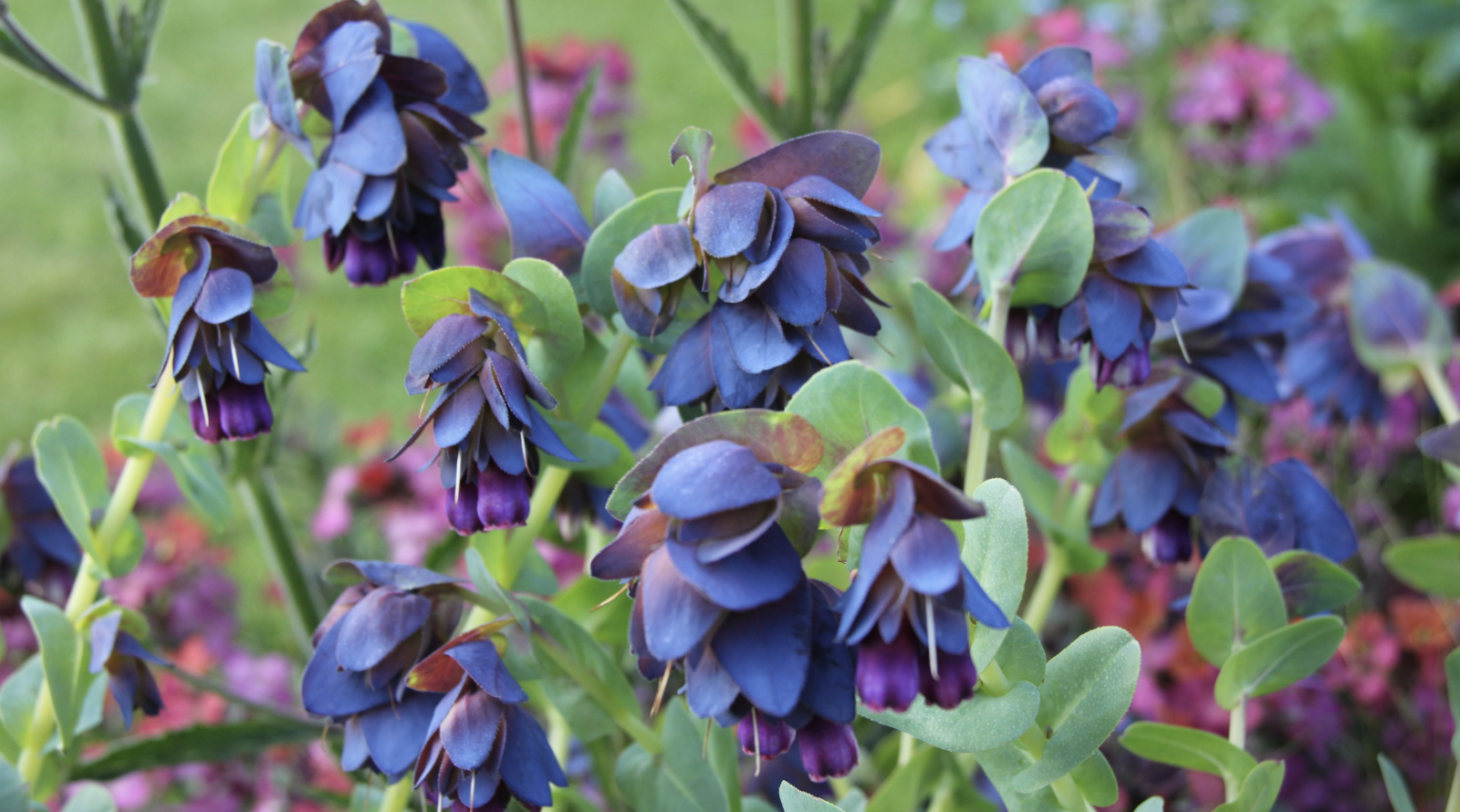
Cerinthe major flowering branch. Image: Chris Jeffree.
It belongs to the Borage family, which includes the familiar blue-flowered plants such as forget-me-not, lung-wort, alkanet and borage itself. You might not immediately recognise it as a member of the Boraginaceae, as it hangs its head and partly hides its flowers by surrounding them with large showy bracts, as if making an apology.
But is has no need to apologise – although an alien, it is a useful ornamental plant and bee-friendly. The tubular flowers are rich in nectar and attract pollinators including bees, butterflies, and other nectar-feeding insects. Bumblebees are frequent visitors and their long tongues allow them to access the nectar hidden within the flowers. In medieval times there was a myth that bees obtained their wax from Honeywort’s leaf surface, and that is probably how it got its sweet name1. However, we now know that worker bees make the hive’s wax using special glands in their abdomens.

Cerinthe major flowers, showing their tubular nature. Also see the tiny bristles on the leaf margins. Image: Chris Jeffree.
Flower colour ranges from creamy yellow (C. major subsp. major) to cobalt blue and deep violet-purple (in Britain the blue form is now the popular garden variety – Cerinthe major subsp. purpurascens). There are good images of the yellow-flowered wild type, from Malta, here. As with many garden species, it has sometimes escaped into the wild, but there is no sign of it becoming invasive. In New Zealand, where it was introduced as a garden plant as recently as 1980, it has often been recorded in the wild (both in North and South Islands), but this does not seem to worry conservationists (no-one claims it to be ‘invasive’). They have a blue variety named ‘Kiwi Blue’ (suggesting general acceptance of the species by New Zealanders).

Cerinthe major, showing the glaucous, water-repellent surface of the leaves. Image: CHris Jeffree.
The history of Honeywort in Britain is less clear. It was known to Gerard in 1597 who described it in detail as a garden plant with yellow flowers, never found in the wild. His description is somewhat at variance with what we know today as Honeywort, although his illustration is a good likeness. About the leaves he says: “set with very sharp prickles like the rough skin of a Thornback, of a bluish green colour, spotted very notably with white streaks and spots”. The Thornback is a species of fish (it’s a Ray, and has a rough skin). I don’t recognise this ‘skin’ character on Cerinthe, although there are short prickles on the leaf margins. Many members of the Boraginaceae do have rough leaves and so it is possible that our ‘modern’ garden cultivars are different from Gerard’s more ‘wild type’ (I have not had an opportunity to examine Mediterranean examples to check this). He was right about the ‘white streaks and spots’, which resemble those of another family-member, lungwort (Pulmonaria officinalis).

Scanning Electron Micrograph of the epicuticular wax on leaves of Cerinthe major. Note the dimensions shown in the lower right hand corner. The intricate worm-like structures are smaller than the wavelength of light, and they scatter light and give the leaf a bright, silvery, appearance. Image: Chris Jeffree.
Gerard was also right about the winter-tenderness of this species: “The root perisheth at the first approach of winter”. It usually does not survive British winters, and so it is grown as an annual, flowering in the spring and producing a good crop of large seeds by the autumn. In a mild winter it might survive: the Royal Horticultural Society say it can be annual, biennial or perennial. Usually, it ‘self-seeds’ and so re-appears every year.

Cerinthe major seedling, showing white tubercules on upper surface of leaf. Compare with leaves of Lungwort, here. Image: Chris Jeffree.
What about its habitat? In its Mediterranean homeland it is found in “a variety of open and semi-open environments, such as meadows, grassy plains, dry grasslands, rocky slopes, scrublands, and disturbed areas like roadside verges and river valleys..”. In Britain, the BSBI Atlas 2020 says: “occasionally occurring as a casual on pavements, dumped soil and in waste places close to human habitations”. In Scotland it has been recorded only seven times, often in the north, in the period 2007 – 2024.
What I find remarkable is the abrupt appearance of Honeywort in England from the year 2000 onwards, despite it having been a garden plant since Gerard’s time (late 16th Century). This could of course reflect the behaviour of BSBI Recorders, who were less inclined to record garden plants found in the wild, but are now happy to do so.

Seeds are quite large, from 6mm to 10mm. Image: Chris Jeffree.
Honeywort is traditionally consumed as a wild edible plant in parts of Italy. Ethnobotanical studies have recorded its use in regions like Sicily, where the young aerial parts and leaves are picked and mixed raw into a traditional seasonal salad alongside oranges. The flowers are also occasionally used as an edible, honey-flavoured garnish or decorative addition for salads and desserts.

Cerinthe major, distribution as seen in 1999 and in 2026. There are seven Scottish records but not all have been mapped. From BSBI/Maps.
Rather little work has been done on the possible pharmaceutical properties of this plant but a 2026 report concluded “this species is a promising source of minerals and bioactive compounds with potential nutraceutical and pharmaceutical applications”.

Yellow flowers on Cerinthe major from the wild, in Sicily. Attribution: Robert Flogaus-Faust, CC BY 4.0 https://creativecommons.org/licenses/by/4.0, via Wikimedia Commons
Notes
1 The name “Cerinthe” comes from the Greek words keros, meaning “wax,” and anthos, meaning “flower.”
2 This species was once featured as Plant of the Week in the Guardian, see https://www.theguardian.com/lifeandstyle/2012/jun/01/plant-of-week-honeywort
3 The image at the head of this article was made by Chat GPT. I was curious to see what AI can do, and the result impressed me.
References consulted
Benaicha Y et al. (2026) Phenolic Profile and Multitarget Bioactivities of Cerinthe major L. Extracts. Natural Product Communications, 21(3), 1934578X261433835.
Biscotti N and Pieroni A (2015) The hidden Mediterranean diet: wild vegetables traditionally gathered and consumed in the Gargano area, Apulia, SE Italy. Acta Societatis Botanicorum Poloniae, 84(3).
Nocentini D, et al. (2012) Flower morphology, nectar traits and pollinators of Cerinthe major (Boraginaceae-Lithospermeae).” Flora-Morphology, Distribution, Functional Ecology of Plants 207.3 :186-196.
©John Grace